
The 3.3T refers to the twin-turbocharged 3.3-liter T-GDI V6 engine used in the earlier-generation Genesis G80. Genesis specifies SAE 5W-30 engine oil meeting the appropriate ACEA A5/A5/B5 specification, depending on model year and market.
Genesis G80 3.3T Engine Oil Capacity
The Genesis G80 3.3T engine oil capacity is 7.29 US quarts (6.9 liters) with an oil and filter change.
| Specification | Genesis G80 3.3T |
|---|---|
| Engine | 3.3L Twin-Turbo V6 |
| Engine type | 3.3 T-GDI |
| Oil capacity | 7.29 US qt (6.9 L) |
| Approximate capacity | 7.3 quarts |
| Recommended viscosity | SAE 5W-30 |
| Oil specification | ACEA A5/A5/B5, depending on model year |
| Oil change | Drain and refill |
| Oil filter | Replace during oil change |
A complete oil change on the Genesis G80 3.3T requires approximately 7.29 US quarts or 6.9 liters of engine oil. Because oil remains in various engine passages and components after draining, it is better to add the oil gradually rather than pouring the entire capacity into the engine immediately.
For a normal oil change, start by adding approximately 6.5 quarts. Run the engine briefly, shut it off, allow the oil to settle, and then check the oil level. Add small amounts until the level reaches the appropriate mark on the dipstick.
The stated 7.29-quart capacity is a reference for a drain-and-refill service, so the exact amount required during an individual oil change can vary slightly depending on how completely the old oil drains.
Related 3.5 EcoBoost Engine Oil Capacity(+ Best Recommended Oils)
Best Engine Oils for Genesis G80 3.3T
1. Castrol EDGE Professional A5 5W-30
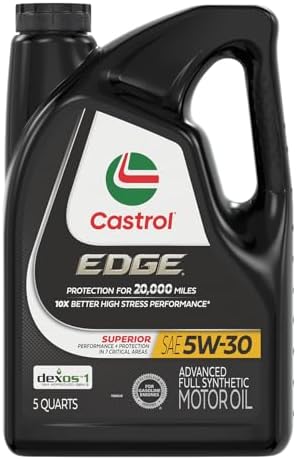
- 3X Stronger than the leading full synthetic*
- 10X Better high stress performance**
- 20,000 miles between oil changes***
- Full-synthetic engine oil
- SAE 5W-30 viscosity
- Designed for high-performance gasoline engines
- ACEA A5/B5 specification
- Provides strong protection against engine wear
- Suitable for turbocharged engines
- Helps maintain engine cleanliness
- Good choice for the Genesis G80 3.3T
2. Valvoline European Vehicle 5W-30

- Advanced protection for European gasoline and diesel engines against the four main causes of engine breakdown: wear, fri…
- Contains low-SAPS (Sulfated Ash, Phosphorus, and Sulfur) for compatibility with the emissions system
- Exceptional high/low temperature protection to defend your engine in extreme driving conditions and climates
- Full-synthetic formulation
- SAE 5W-30 viscosity
- European-style formulation for demanding engines
- Available in formulations meeting ACEA specifications
- Provides protection against wear and deposits
- Helps maintain performance under high temperatures
- Suitable for modern turbocharged gasoline engines
- Check the bottle for the exact ACEA approval before purchasing
3. Mobil 1 5W-30 Full Synthetic

- Mobil 1 advanced full-synthetic motor oil 5W-30 utilizes Mobil 1’s signature Triple Action Formula to deliver outstandin…
- Helps protect critical engine parts for up to 10,000 miles between oil changes,* controlling oxidation to prevent oil br…
- Meets ILSAC GF-6 standards to help provide low-speed pre-ignition (LSPI) and timing chain wear protection while keeping …
- Full-synthetic motor oil
- SAE 5W-30 viscosity
- Excellent high-temperature protection
- Helps reduce engine wear
- Designed to resist oil breakdown
- Helps protect against sludge and deposits
- Suitable for turbocharged engines
- Check the specific product label to confirm compatibility with the required ACEA specification
Related 1ZZ FE Engine Oil Capacity(+Best Recommended Oil)
What Oil Does the Genesis G80 3.3T Use?
The earlier G80 3.3 T-GDI owner’s manuals specify SAE 5W-30 and an ACEA A5-type specification for the engine. The 2019 and 2020 G80 manuals list the 3.3 T-GDI at 7.29 US qt (6.9 L) and specify ACEA A5.
For the 3.3T engine, selecting oil based only on viscosity is not ideal. Look for an engine oil that meets the specification listed in the owner’s manual for your exact model year and market.
Because the G80 3.3T is a turbocharged gasoline engine, using the correct full-quality synthetic oil is particularly important. Turbochargers operate at very high temperatures and depend on engine oil for lubrication and heat management.
Is 5W-30 the Best Oil for the G80 3.3T?
For the earlier 3.3 T-GDI G80, 5W-30 is the factory-listed viscosity in the applicable owner’s documentation. The exact oil specification can vary by model year and market, so owners should check their vehicle’s manual before selecting an alternative viscosity.
The “5W” portion describes the oil’s low-temperature performance, while “30” describes its viscosity at operating temperature. A 5W-30 oil therefore provides relatively good cold-start flow while maintaining the viscosity characteristics expected by the engine when hot.
Avoid choosing a different viscosity simply because it is marketed as a premium or high-performance oil. The correct specification is more important than choosing an oil based solely on brand or marketing claims.
Related Lifan 110cc Engine Oil Capacity(+ Recommended Oil)
Why Oil Capacity Matters on a Twin-Turbo Engine
Correct oil level is particularly important in the G80 3.3T because its twin-turbocharged V6 relies on properly lubricated moving components and turbochargers.
Too little oil can reduce the amount of lubrication available to critical engine components. Low oil levels may also increase the risk of accelerated wear under demanding driving conditions.
Overfilling is also undesirable. Excessive engine oil can cause problems such as aeration or increased crankcase pressure. For this reason, do not assume that adding more oil provides additional protection.
The safest approach is to use the specified capacity as a starting point and then verify the final level using the vehicle’s oil-level checking procedure.
Related 2024 Ford F150 5.0 Oil Capacity(+Best Recommended Oil)
How to Change the G80 3.3T Engine Oil
Changing the engine oil is relatively straightforward, although the vehicle should be safely supported and the manufacturer’s service procedures followed.
1. Warm the engine
Run the engine for a few minutes so the oil becomes warm. Warm oil generally drains more easily than cold oil.
2. Park on a level surface
Turn the engine off and park the G80 on a level surface. If the vehicle needs to be raised, use appropriate lifting equipment and secure it properly.
3. Drain the old oil
Remove the drain plug and allow the old engine oil to drain completely into a suitable drain pan. Be careful because the oil may be hot.
4. Replace the oil filter
A new oil filter should normally be installed during every oil change. Lubricate the filter gasket with a small amount of clean engine oil before installation if required by the filter manufacturer’s instructions.
5. Reinstall the drain plug
Install the drain plug with the appropriate sealing washer if required. Tighten it according to the factory service specification rather than guessing the torque.
6. Add new oil
Add approximately 6.5 quarts initially, using the recommended 5W-30 oil and the correct specification.
7. Check the level
Start the engine and allow it to run briefly. Shut it off and wait several minutes for the oil to drain back into the sump. Check the oil level and add oil gradually until it reaches the correct level.
Related 2018 Ford F150 5.0 Oil Capacity(+Best Recommended Oil)
How Often Should You Change the Oil?
Oil-change intervals depend on the model year, driving conditions, oil specification, and the maintenance schedule provided for the vehicle.
Vehicles that experience frequent short trips, extensive idling, heavy traffic, dusty conditions, extreme temperatures, or repeated high-load driving may require more frequent maintenance than vehicles primarily used for steady highway driving.
Rather than relying on a generic interval, follow the maintenance schedule for your particular G80 3.3T. Using the correct oil and replacing the filter regularly helps maintain lubrication and engine performance.
G80 3.3T vs. Newer G80 Engines
One important point is that not every G80 with a turbocharged V6 uses the same oil capacity. The first-generation G80 used the 3.3 T-GDI engine, while newer G80 models moved to different engines.
For example, Genesis documentation for the 2021 G80 lists the 3.5L T-GDI engine with a capacity of 7.4 US qt (7.0 L), while the 2.5L T-GDI is listed at 6.5 US qt (6.2 L).
Therefore, do not use the 7.29-quart figure simply because your vehicle is called a G80. Always identify the engine first.
FAQs
How many quarts of oil does a Genesis G80 3.3T take?
The Genesis G80 3.3T takes 7.29 US quarts (6.9 liters) of engine oil for a drain-and-refill service.
What oil viscosity does the G80 3.3T use?
The applicable G80 3.3 T-GDI owner’s manuals specify SAE 5W-30, with the required ACEA specification depending on model year and market.
Should I use synthetic oil?
A quality full-synthetic oil that meets the required specification is a sensible choice for the turbocharged 3.3 T-GDI engine. Always prioritize the specification and viscosity listed for your specific vehicle.
Does the 2021 G80 use the same oil capacity?
No. The 2021 G80 introduced different engine options, including the 3.5L T-GDI. Genesis lists the 3.5L T-GDI at 7.4 US qt (7.0 L), so the 3.3T capacity should not be applied to that engine.
Final Thoughts
The Genesis G80 3.3T engine oil capacity is 7.29 US quarts (6.9 liters) for a drain-and-refill oil change. The earlier 3.3 T-GDI V6 is designed around SAE 5W-30 engine oil meeting the applicable ACEA specification.
When changing the oil, replace the oil filter, add oil gradually, and verify the final level rather than relying solely on the stated capacity. Most importantly, confirm the model year and engine before servicing because newer G80 models use different engines and have different oil capacities.